

Imagine a disc that can store movies in sharp video and clear sound while holding much more data than a DVD. Yes, that is what Blu-ray is.
Interested in finding out more about it? In this write-up, you will get all the details. You will learn how Blu-ray started, its region codes, encryption and protection, and resolution. Not only that, but you will also discover a program that lets you turn your Blu-ray discs into digital formats for easier viewing.
It is going to be a lot of useful information, so please read on and get the full picture about Blu-ray!

Part 1. What Are Blu-ray Discs
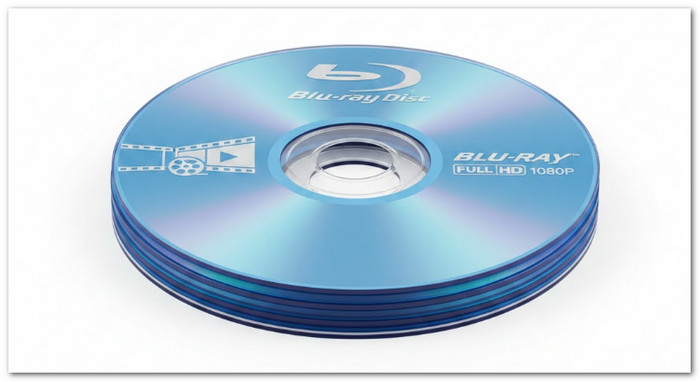
If you have ever wondered what Blu-ray discs are, they are the reason movies can look so much better than DVDs today.
A Blu-ray disc is a type of digital optical disc made to replace DVDs. It can store high-definition video and large data files. The term "Blu-ray" comes from the blue laser it uses. A blue laser has a smaller wavelength than the red laser in DVDs, which lets it store more data in the same space.
How Blu-ray Started
Blu-ray was developed by the Blu-ray Disc Association (BDA). Big tech companies supported it. In 2006, Blu-ray players and discs became available to the public.
Blu-ray competed with HD DVD at that time. In 2008, HD DVD was discontinued. Blu-ray became the main high-definition disc format worldwide.
4K UHD Blu-ray
Years later, a newer version arrived called 4K Ultra HD Blu-ray. It was released in 2016. 4K UHD Blu-ray offers:
- Higher resolution
- Better color
- Higher dynamic range (HDR)
- Improved compression
It supports HDR formats like HDR10 and sometimes Dolby Vision. It gives brighter highlights and deeper blacks.
Storage Capacity
Blu-ray discs come in different sizes:
- 25GB (single layer)
- 50GB (dual layer)
- 100GB (triple layer for 4K UHD)
- 128GB (quad layer for some UHD discs)
More space means better video quality and less compression.
Video Codecs
Blu-ray uses advanced video compression to keep quality high while saving space. If you are curious what codec Blu-ray uses, the common video codecs include MPEG-2, AVC (H.264), and VC-1. 4K UHD Blu-ray mainly uses HEVC (H.265). This codec handles 4K video better and keeps the file size smaller.
Audio Codecs
Blu-ray supports high-quality audio formats such as:
- Dolby Digital
- DTS
- Dolby TrueHD
- DTS-HD Master Audio
These formats allow lossless audio. That means the sound is very close to the original studio recording.
Disc Structure
A Blu-ray disc has layers:
- A protective coating
- A data layer
- A substrate layer
The data is stored in tiny pits. The blue laser reads these pits to play the movie or data.
Region Codes
Blu-ray discs use region codes to control where they can be played. If you are curious what Blu-ray region is USA, it belongs to Region A.
The main regions are:
- Region A - North and South America, Japan, Korea
- Region B - Europe, Africa, Australia
- Region C - Asia except Japan and Korea
Some discs are region-free, which means they can play anywhere without restriction using a region-free Blu-ray player.
Encryption & Protection
Blu-ray uses strong copy protection systems. The main one is AACS (Advanced Access Content System).
4K UHD Blu-ray uses a newer version called AACS 2.0. These systems help prevent illegal copying.
Part 2. What Resolution Is Blu-ray
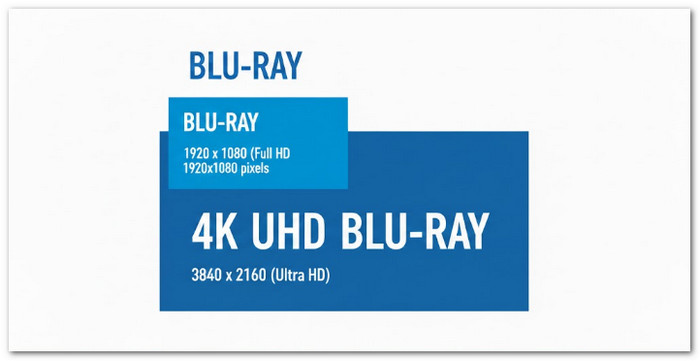
Many people buy Blu-ray for a better picture. If you are wondering what resolution Blu-ray has, here is the answer.
Standard Blu-ray supports 1080p resolution. That means 1920×1080 pixels. It is called Full HD. The "p" means progressive scan. It gives smooth and sharp images. Blu-ray can also support 720p and 1080i, but most movies are in 1080p. It is the common and best format for standard Blu-ray.
4K UHD Blu-ray is different. It supports 3840×2160 resolution. That is four times the pixels of 1080p. It is called Ultra HD or 4K. It shows more detail. It looks sharper on big screens.
Part 3. Blu-ray vs. Streaming - Is Blu-ray Still Competitive
There is no doubt that streaming is quick. You open Netflix or Disney+ and start watching. It feels easy. But Blu-ray still wins in quality. It uses a higher bitrate. The picture looks sharper. Dark scenes keep more detail. The sound is richer and closer to studio quality. Streaming depends on internet speed. Blu-ray does not. It plays the same way every time. There is also ownership. Streaming gives access. Blu-ray gives control. The movie cannot vanish from your shelf.
Now think about this. What if you want Blu-ray quality without always using a disc? It is where Tipard Blu-ray Converter helps. It makes Blu-ray more flexible and modern. You can rip Blu-ray to common video formats like MP4, AVI, MOV, WMV, and MKV. If you want to keep everything the same as the disc, you can rip Blu-ray losslessly to MPG or MKV. It keeps the original video quality. It keeps audio tracks, subtitles, and chapters. The structure stays almost untouched.
A Blu-ray disc often has many video files. Tipard Blu-ray Converter lets you convert all of them at once. You can also merge them into one single video. It saves time. It keeps your movie clean and organized. It also supports full GPU acceleration. Your graphics card helps decode, edit, and encode videos faster.
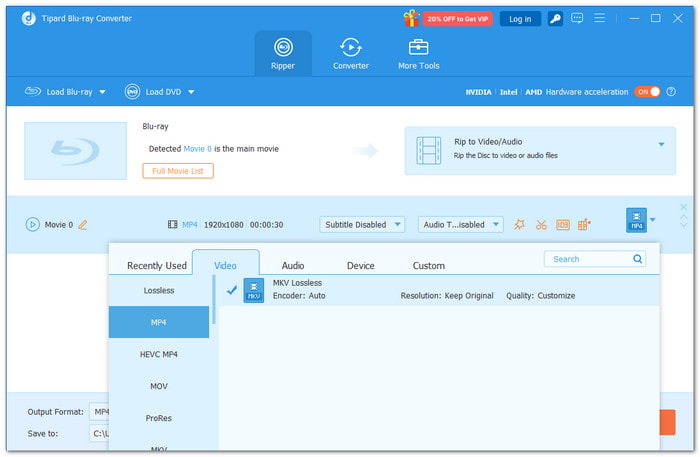
So is Blu-ray still competitive? Yes. It offers stable quality and true ownership. With Tipard Blu-ray Converter it also offers freedom. You keep the power of Blu-ray and enjoy the ease of digital viewing. That makes it a strong choice even today!
Part 4. FAQs of What Blu-ray Is
Is Blu-ray really better than DVD?
Yes. Blu-ray shows sharper pictures and clearer colors. DVDs play at 480p while Blu-ray plays at 1080p. That means Blu-ray has more detail. It also supports lossless audio. That makes the sound clearer and stronger. On big TVs, the difference is easy to see.
Can I play Blu-ray on a normal DVD player?
No. DVD players use a red laser, but Blu-ray discs need a blue laser. The lasers and discs are not compatible. Blu-ray players can usually play DVDs, so upgrading keeps your old movies safe.
Why is Blu-ray being discontinued?
Blu-ray is not fully gone, but less popular. Digital streaming platforms like Netflix make watching movies easy. People like instant access. Because of that, stores sell fewer discs.
Conclusion
There you go! You have learned the Blu-ray meaning. To sum up, it is a high-capacity disc that stores high-definition video and clear, high-quality audio.
To make Blu-ray even more useful, you can use Tipard Blu-ray Converter to rip Blu-ray discs to popular video file formats like MP4, AVI, MOV, and MKV. You can keep the original video quality, audio tracks, subtitles, and chapters. It really helps you unlock the full power of Blu-ray and enjoy your movies your way!
More Reading



About the Author

 Click here to join the discussion and share your comments
 Tipard Blu-ray Converter