

Key Takeaways
AI video enhancement can greatly improve video quality. Consider these important points before choosing a video enhancer:
- AI upscaling: Increase resolution while preserving visual details.
- Noise reduction: Remove grain, artifacts, and unwanted distortions.
- Graphics card support: Modern GPUs can accelerate AI enhancement tasks.
- Video restoration: Improve colors, brightness, and overall clarity.
- Output quality: Results depend on source footage and AI technology.
- Performance and value: Compare speed, features, compatibility, and cost.
Video quality enhancers are software applications that take advantage of AI algorithms to upscale and enhance the quality of videos by removing noise and restoring their original high-resolution images. The ten best video enhancers have been compiled into this article based on their advantages/disadvantages, level of performance, value for money, etc.

Part 1. Quick Comparison of the Top 10 Video Enhancers
| Video Enhancer | 4K Output | 8K Output | Face Enhancement | Color Enhancement | Noise Reduction | Video Stabilization |
|---|---|---|---|---|---|---|
| Tipard Video Converter Ultimate | ✓ | ✓ | ✓ | ✓ | ✓ | ✓ |
| AVCLabs Video Enhancer AI | ✓ | ✖ | ✓ | ✓ | ✓ | ✖ |
| HitPaw Video Enhancer | ✓ | ✖ | ✓ | ✖ | ✓ | ✖ |
| Topaz Video AI | ✓ | ✓ | ✖ | ✖ | ✓ | ✖ |
| DaVinci Resolve | ✓ | ✖ | ✓ | ✖ | ✓ | ✖ |
| UniFab Video Enhancer | ✓ | ✖ | ✖ | ✖ | ✓ | ✖ |
| VideoProc Converter AI | ✓ | ✖ | ✖ | ✖ | ✓ | ✖ |
| DVDFab Enlarger AI | ✓ | ✖ | ✖ | ✖ | ✓ | ✖ |
| TensorPix | ✓ | ✖ | ✖ | ✖ | ✓ | ✖ |
| Adobe Premiere Pro | ✓ | ✖ | ✓ | ✖ | ✓ | ✓ |
| Show MoreShow Less | ||||||
Part 2. How We Tested the Video Quality Enhancers
We tested these video enhancers using identical clips and similar settings for fair comparison. Results were measured on the same system, though faster hardware and dedicated GPUs may deliver quicker processing performance.
- Test video size: 2-5 GB per file
- Source resolutions: 480p, 720p, and 1080p.
- Target resolution: 1920×1080 and 3840×2160 (4K) when supported
- Computer Processor: Intel Core i5-12400 (2.50 GHz) Computer Graphics: Intel UHD Graphics 730
- Judging rules: Upscale Quality, Details brought back, noise suppression, Processing time, usability, Output compatibility, and general value.
- Goal: Enhance the clarity and visual quality of videos, with good coordinates and smooth playback, but without any artificial appearance.
Part 3. Detailed Review of the 10 Video Enhancer Software
1. Tipard Video Converter Ultimate
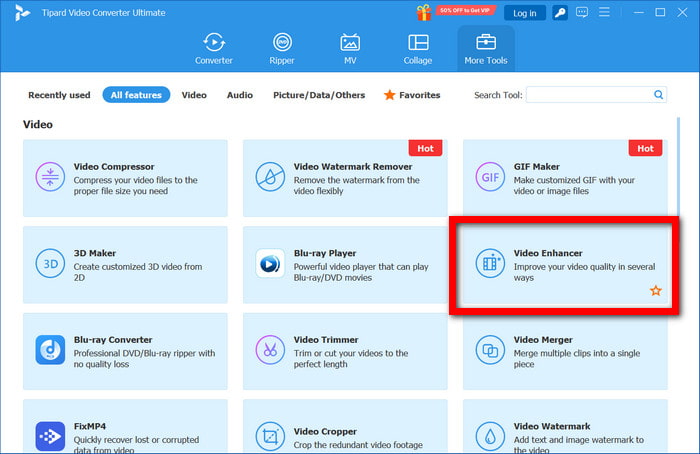
Best for: All tasks, video enhancement, media management.
Tipard Video Converter Ultimate has video enhancement features, but that's far from its scope. It provides video converting, editing, compression, DVD tools, and AI tools for supporting quality improvement in a single tool. It was found to be consistent in improving the quality of tests, quick processing speed, and wide format compatibility, making it more usable for newcomers and veteran users alike, taking into consideration.
Key Features:
- Accelerate GPU video enhancement to get it playing quicker.
- Introduce AI video enhancement tools to enhance video quality.
- Send input video: support all input video formats.
- Quick video enhancing options with 1 click options.
- Excellent all-in-one solution.
- Fast processing speed.
- Wide format compatibility.
- Several bonus features added.
- More advanced features might be intimidating to the new user.
Test Result:
Tipard Video Converter Ultimate provided the right enhancement quality and speed. There was a marked enhancement of the visual clarity, and processing continued without impediment.
Processing speed: 12 min 34 sec (GPU acceleration)
Source resolution: 720p
Output resolution: 1080p
CPU usage: 18%
Enhancement result: Sharpness, noise, and brightness were enhanced, and natural details were retained.
2. AVCLabs Video Enhancer AI
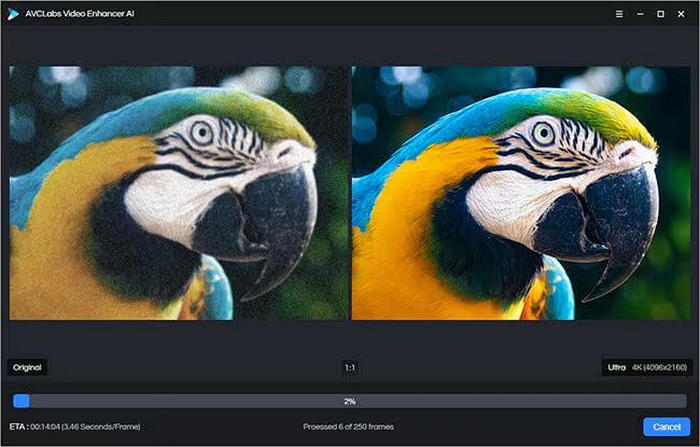
Best for: Converting old and poor-quality videos for easy AI enhancement.
AVCLabs Video Enhancer AI is designed with ease of use in mind, but not skimping on quality. Users looking for quality-driven enhancements with minimal manual effort will find it to be a great choice as its AI models automatically add details, improve faces, and minimize noise.
Key Features:
- AI upscaling.
- Face enhancement.
- Noise reduction.
- Color enhancement.
- Batch processing.
- Easy to use.
- Good quality output.
- Clean interface.
- Subscription pricing.
- Limited manual controls.
Test Result:
AVCLabs made good improvements on aging footage & home videos.
Processing speed: 29 minutes & 11 seconds
Source resolution: 720p
Output resolution: 4K
CPU usage: 22%
Enhancement result: Face details and video clarity were enhanced.
3. HitPaw Video Enhancer
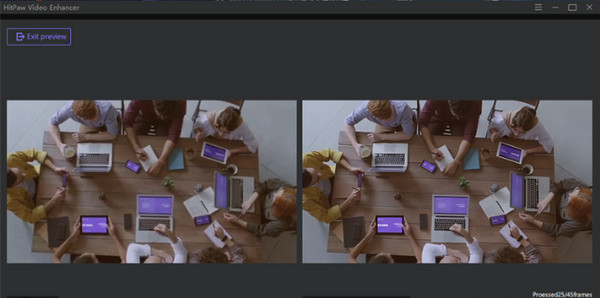
Best for: Quick improvement and blogging.
The primary target of HitPaw Video Enhancer is to deliver high-quality enhancement performance while being fast. It has the flexibility to be used with multiple AI models for optimizing various types of content, making it a great option for creators who need to work with videos regularly.
Key Features:
- AI upscaling.
- Face enhancement.
- Denoise technology. Batch processing.
- Fast rendering speed.
- User-friendly interface.
- Multiple AI models.
- Reliable enhancement quality.
- Limited advanced controls.
- There are some premium features.
Test Result:
HitPaw has provided a pretty solid mix of quality/performance.
Processing speed: 21 minutes and 15 seconds
Source resolution: 720p
Output resolution: 1080p
CPU usage: 20%
Enhancement result: The image showed an improvement in detail and decreased compression artifacts.
4. Topaz Video AI
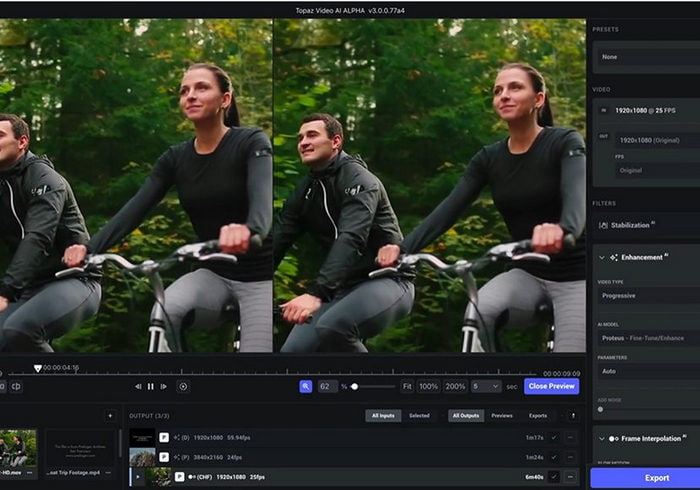
Best for: Professional restoration and best quality upscaling.
Topaz Video AI is currently one of the most powerful enhancement tools that exists. Its AI algorithms do a better job of recovering details than many other competitors can, and can perform dramatically well on very low-quality and heavily compressed video.
Key Features:
- 8K upscaling is supported via AI.
- Advanced denoising.
- Frame interpolation.
- Multiple AI models.
- Excellent detail recovery.
- Extensive customization.
- Professional-grade results.
- Expensive.
- Slow processing.
- Demanding hardware requirements.
Test Result:
This is in reference to the highest quality generated from all the software tested, which was Topaz.
Processing speed: 15 minutes and 25 seconds
Source resolution: 480p
Output resolution: 4K
CPU usage: 28%
Enhancement result: Fixed-in information and minimized the excessive visual noise.
5. DaVinci Resolve
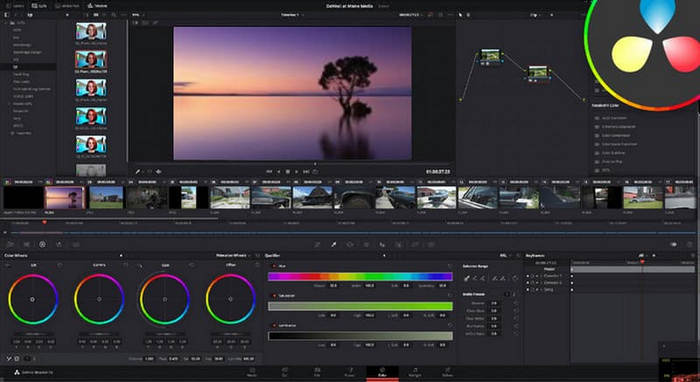
Best for: Editing and enhancing for professionals.
DaVinci Resolve packs in those sophisticated editing options along with its best-in-class enhancement options. For those willing to put in some effort to learn the program, its Super Scale technology and professional color-grading tools make it a great choice.
Key Features:
- Super Scale upscaling.
- Color grading tools.
- Noise reduction.
- Professional editor.
- Multi-platform support.
- Free version available.
- Professional feature set.
- Excellent color correction.
- Steep learning curve.
- Resource-intensive.
Test Result:
No stone was left unturned in the professional level of image enhancement and color accuracy supplied by Resolve.
Processing speed: 33 minutes and 52 seconds.
Source resolution: 720p
Output resolution: 4K
CPU usage: 26%
Enhancement result: The resolution and visual quality have been enhanced.
6. UniFab Video Enhancer
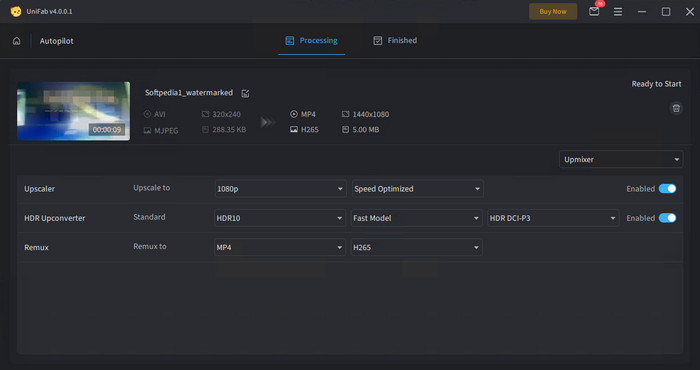
Best for: Batch enhancements.
The goal of UniFab Video Enhancer is to let large batches of video documents be handled. It offers batch-processing functionality, streamlining and ensuring the enhancement quality in each file remains the same.
Key Features:
- AI upscaling.
- Noise reduction.
- Automated presets.
- Hardware acceleration.
- Excellent batch processing.
- Consistent results.
- Good automation tools.
- Windows-only.
- Subscription-based.
Test Result:
Efficiently processed several videos to high quality by UniFab.
Processing speed: 35 minutes and 14 seconds.
Source resolution: 720p
Output resolution: 1080p
CPU usage: 21%
Enhancement result: Multiple videos have been enhanced, and consistent quality has been provided.
7. VideoProc Converter AI
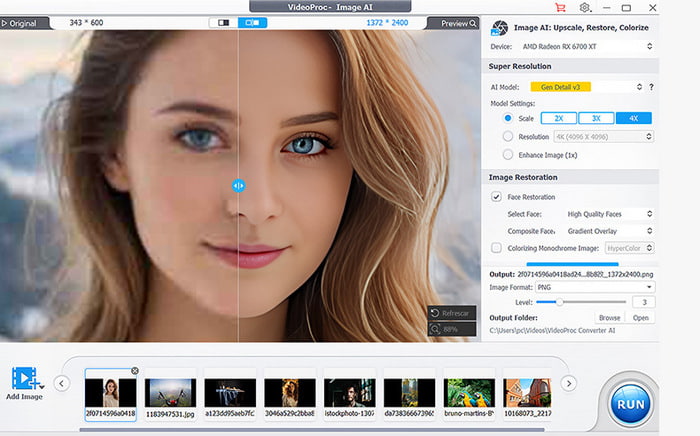
Best for: Media Utilities and enhancement.
VideoProc Converter AI is an all-in-one tool that enhances, converts, compresses, and records video. It is more about versatility and affordability than simply the quality of the AI restoration.
Key Features:
- AI upscaling.
- Video conversion.
- Screen recorder.
- Video editor.
- Affordable pricing.
- Multiple built-in tools, such as speeding up video.
- Fast performance.
- Easy operation.
- Moderate enhancement quality.
- Lower-level advanced AI capabilities.
Test Result:
VideoProc was helpful in basic enhancement for videos and running basic media processing.
Processing speed: 20 minutes
Source resolution: 720p
Output resolution: 1080p
CPU usage: 17%
Enhancement result: Solved clarity is improved, and fast export speeds.
8. DVDFab Enlarger AI
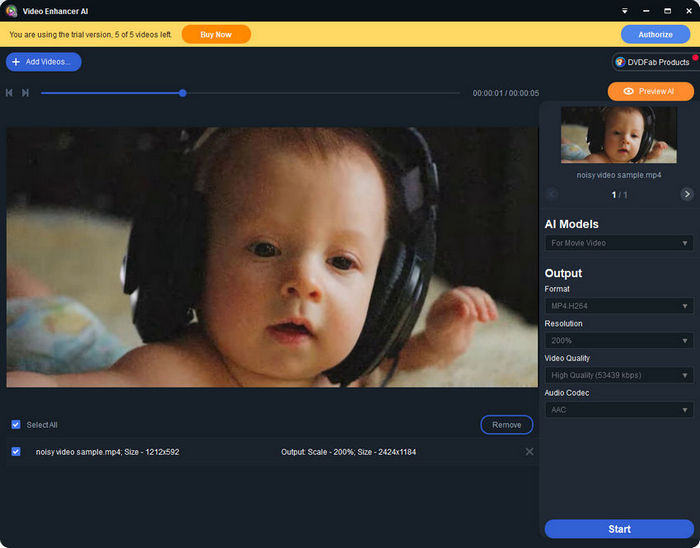
Best for: DVD and standard-definition videos.
The DVDFab Enlarger AI has special features to cater to older video sources. Its enhancement technology concentrates on enhancing SD and DVB content as well as DVD-quality content, which makes it an effective tool for archive and digitization projects.
Key Features:
- AI DVD upscaling.
- Noise reduction.
- DVD integration.
- Hardware acceleration.
- Excellent DVD enhancement.
- Effective SD upscaling.
- Easy workflow.
- Windows-only.
- Limited flexibility.
Test Result:
The disc conversion software, DVDFab, made some of the best conversions to DVD-quality footage.
Processing speed: 51 minutes and 10 seconds.
Source resolution: 480p
Output resolution: 1080p
CPU usage: 24%
Enhancement result: achieved successfully, improving DVD images while keeping their quality.
9. TensorPix
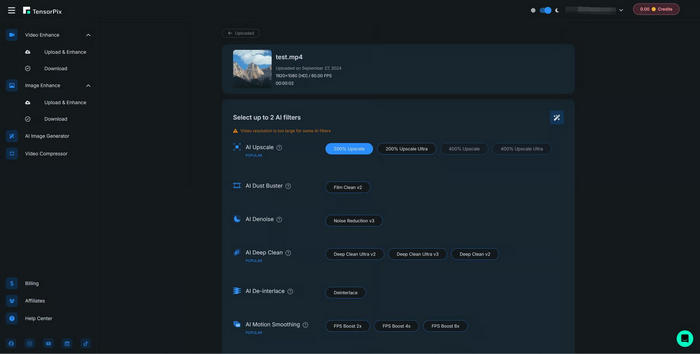
Best for: Video enhancing in the cloud.
The video processing occurs in the cloud via TensorPix, which is able to perform this task without powerful local hardware. This allows features in its enhancement process to be accessed even by older computers and lower-end devices.
Key Features:
- Cloud AI processing.
- Video upscaling.
- Noise reduction.
- Multi-device support.
- No hardware requirements.
- Complies with most devices.
- Easy accessibility.
- An internet connection is required for cloud processing and video watermark remover access.
- Upload/downloading delays.
Test Result:
The enhancement quality offered by the TensorPix was good, provided with cloud processing.
Processing speed: 18 minutes (including upload time)
Source resolution: 720p
Output resolution: 4K
CPU usage: Minimal
Enhancement result: Resolution and noise have been increased successfully.
10. Adobe Premiere Pro
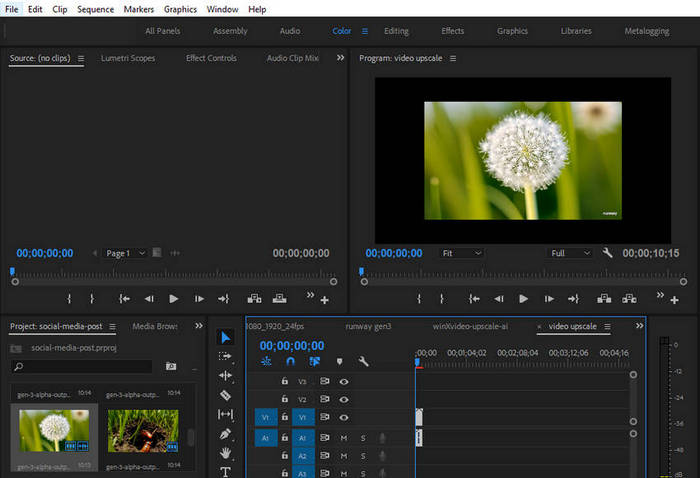
Best for: Adobe users and experienced editors.
Adobe Premiere Pro seamlessly incorporates enhancement tools into a time-proven editing workflow. It is not only a video enhancement software, but it also has many features for improving video quality, compressing a video, and more.
Key Features:
- Built-in upscaling.
- Lumetri Color tools.
- Noise reduction.
- Video stabilization.
- Industry-standard editor.
- Powerful color tools.
- Extensive plugin support.
- Integrated workflow.
- Subscription required.
- Not AI-focused.
Test Result:
Premiere Pro proved to be reliable for the enhancements and did not sacrifice efficiency during the editing process.
Processing speed: 31:46 mins.
Source resolution: 1080p
Output resolution: 4K
CPU usage: 25%
Enhancement result: Successfully professionally used editing routines to enhance image quality.
Part 4. Key Factors to Consider When Choosing an AI Video Enhancer
The key to getting more out of your video lies in selecting the right AI video enhancer.
- Color Improvement: Enhance the accuracy of color, without introducing unrealistic visual artifacts.
- Improved Processing Speed: When enhancing long videos or multiple files frequently, it can save a tremendous amount of time.
- AI enhancement and rendering performance are greatly boosted with the new NVIDIA, AMD & Intel Graphics Cards.
- Supported video formats: Wide compatibility with video formats makes your job easier when handling videos from various devices and sources.
- Rates and Worth: Be careful in analyzing the cost of software, the features it has, the quality of software enhancements, and the total value of the software in the long run.
Part 5. FAQs of Video Enhancer
Does AI video enhancement increase file size?
Yes. Enhanced videos are more likely to be at greater bitrates, higher resolution, and higher quality settings, and therefore take up more space. Post-production videos with video compression can help decrease the amount of storage needed while keeping video quality high.
Can AI video enhancers improve old home videos?
Yes. AI video enhancers can de-noise, enhance sharpness, stabilize video, and enhance colors. For older home videos, VHS format, and camcorder footage, AI can extract data that may have been lost over time. AI can extract data that has degraded with time, especially with older home videos, VHS tapes, and camcorder footage.
Are AI video enhancers suitable for animation and cartoons?
Yes. Some AI video enhancers also have separate models for enhancing animation videos. These models maintain the accuracy of the line art, enhance the line edges, upscale the resolution, and eliminate artifacts to produce clearer, sharper animated images on contemporary displays.
Conclusion
Video enhancers can do a great job in enhancing video based on the three aspects: upscale, denoise, and restore. Features, performance, and value should be compared to find the most appropriate solution for the various enhancement needs.

All-in-one video toolbox: convert, edit, upscale, enhance, and compress your videos easily
100% Clean & Safe
100% Clean & Safe

More Reading




About the Author


 Tipard Video Converter Ultimate